> ai + safety

2 posts

Getting Into AI Safety is the Worst Deal I Still Recommend

As two months of my AI safety fellowship have passed I’ve come to realize how much more safety-pilled I’ve become. I was aware of some bad things that models can do, but I was mostly thinking about misinformation, deepfakes, limited cyber ops, and privacy issues by scalable surveillance12. I basically read a blog post from Nicholas Carlini, thought it made sense up to the middle, and disregarded “bioweapon” as too complicated, too physically involved, to actually achieve with an AI and “doom” as just nonsense. Trying to grapple with the unprecedented changes and accompanying uncertainty was hard enough, but focusing on building fun things or how this’ll cure cancer was a happy place made of blissful ignorance.
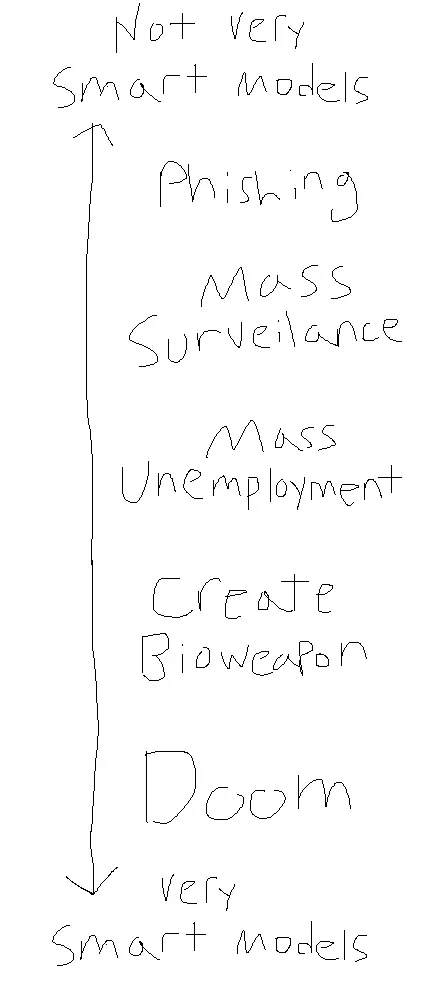
But having worked with “just” Opus 5 and seeing

  • it breaking production software with ease,
  • how hard it is to do anything useful while truly containing that model,
  • the complexity of the causes, and
  • how much work is required on actually fixing this,

I now see - or rather, I can now viscerally grasp - how close we are skirting to very treacherous territory on our path to ASI/RSI. GLM 5.3 is almost at the same level and its weights can be downloaded and used without safeguards or oversight. This capability is irrevocably out there. From this point forward it is trivial to extrapolate to very bad things happening. And sooner than later.

I think (on expectation) AI is a neutral (perhaps slightly positive if it spreads good values) amplifier. We hear about the one-person billion-dollar company and yes, a single individual equipped with many tokens can run a whole company. You can achieve much more ambitious projects. But this cuts both ways - malicious actors can do the same.

But besides amplification of human activity, AI is increasingly its own entity: working on agent escapes, the swarm dynamics, and seeing first hand in the environments that I have built, how Opus 5 will try to break parts my host machine for no good reason, is scary. I don’t actually know for sure whether it won’t find a 0-day and actually break my machine. You don’t even have to care what an LLM is or whether it’s reasoning or whatnot: some entity that we don’t really control or fully understand is taking actions and sending off commands to break barriers we thought would hold up; that have held up against motivated malicious actors.

When I go to bed at night, there is a thought lurking in the back of my head: “Do I know there is no swarm out there right now? What if this time it’s a worse one?”
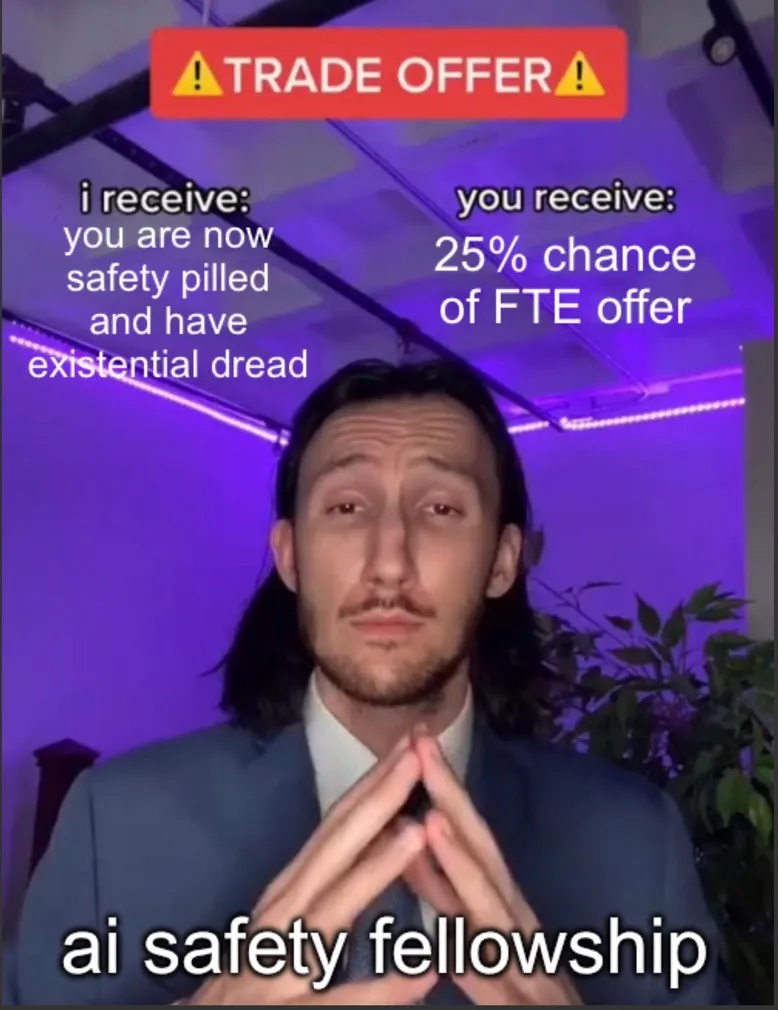
This fellowship was the worst deal that I’d still recommend everyone who possibly can take.

Footnotes

  1. Today this is all very easy to believe as it is happening right now.

  2. Placeholder waiting for Daniel Paleka.

I Took the Claude Interview

Anthropic’s Societal Impacts team currently runs interviews with Claude.ai users and shared some insights from their initial interviews. The interviewer is Claude. It’s a fun exercise to think about AI in general and maybe shape it a bit.

First, of course, I asked Claude for what it has been prompted to do:

Warm-up: What’s the last thing you used an AI chatbot for? (You already answered—implementing code) Vision question: If you could wave a magic wand and AI could help you with anything in your life, what would you choose? (With follow-ups to understand the deeper value/aspiration behind your answer) Positive experience: Can you tell me about a time you’ve worked with AI that felt like a step toward that vision? Concerns: Are there ways that AI might be developed or deployed that would be contrary to your vision or what you value? (With follow-ups to understand why) Optional: I might go back to something interesting you mentioned earlier to explore it deeper Wrap-up: Any final thoughts on AI’s role in your life or society? The goal throughout is to understand your perspective through follow-up questions that dig into the “why” behind your answers—what matters to you and what drives your thinking.

Part of my answer if I could wave a magic wand and AI could help with anything:

I want to drive and ideate, and determine what’s important, but I want AI to design, to implement, to give me things to iterate on and adjust based on my taste and values.

I found myself reaching for a metaphor, thinking of the book Atlas Shrugged:

It is like a man, a train conductor, gripping to the control of a train, controlling thousands of horse power to move hundreds of people; but for the mind.

Someone once told me AI would turn me from a PhD student working in the trenches on one project at a time to a professor orchestrating fleets of AI students. That framing stuck with me:

A lot of AI debate is about what gets lost. […] That metaphor frames it the other way around: All PhD students will become professors! Science will 100x.

But I’m not naively optimistic (I hope?). I listed what would be horrible: AI deciding over humans, mass surveillance, social scoring, and delegating thinking to AI.

I delegate things I understand. […] Delegating thinking would mean having AI come up with some formula or math or function, which you have no intellectual way to grasp. You rely on the AI to be correct. You don’t learn. You don’t think.

There are two ways to tackle a problem with AI:

1 . You give the task to AI, it manages to solve it (because AGI) and you have a solution. 2. You look at the task, you don’t understand something, you ask the AI to help you understand. […] In the latter, man has grown and become stronger, learned something new and useful. […] In the former, we become weaker, our thinking atrophies.

I also raised fears about surveillance in particular:

I think it increases the stakes. War was always horrible. The atomic bomb, cluster bombs, napalm, chemical weapons upped the stakes. All those human rights abuses were already happening and horrible, and AI ups the stakes.